Herbal supplements follow different FDA rules from medications and do not undergo the same level of testing, according to the U.S. Food and Drug Administration. To understand the legal status of feminizing herbs in the United States, distinguish the federal framework for supplements from state restrictions on gender-affirming care for minors.
It is understandable to want a clear answer when herbs are marketed for feminizing transition. Marketing claims do not establish what effects a product will have or whether a particular state restriction applies. This guide explains how FDA oversight of supplements differs from medication regulation, what state rules address, and what is known about herbs commonly promoted for feminizing effects. Use these distinctions to assess product claims and understand which legal questions may apply to your situation.
Key Takeaways
- Learn which herbs are promoted for feminizing effects and what the available evidence does, and doesn’t, show.
- Understand that state restrictions focus on access to gender-affirming care for minors, not on a single nationwide rule for herbs.
- See how FDA oversight of supplements differs from medication regulation, and why marketing claims aren’t proof of effectiveness.
- Explore how Transfemme offerings, including pills and creams, fit into a personal feminization journey.
Herbs marketed for feminizing transition
Herbs marketed for feminizing transition are plant-based products promoted for effects such as breast growth or softer skin. Pueraria mirifica is a Southeast Asian plant often sold in supplements with feminization claims. Phytoestrogens are plant compounds that can interact with estrogen-related pathways in the body.
These terms describe marketing and biology, not proven results. Small studies have examined Pueraria mirifica for menopausal symptoms in cisgender women. No studies have examined Pueraria mirifica in transgender people, so those findings cannot establish its effects during gender-affirming hormone therapy. Products also vary in ingredients and strength, so distinguish label claims from evidence.
There is no standard Pueraria mirifica dose for herbal supplements. A product’s serving instructions should not be treated as an established feminizing treatment schedule. Even if very large amounts of phytoestrogen-containing foods could potentially affect sex hormones, that is not evidence that a particular herb causes breast growth or changes hormone levels.
Are feminizing herbs approved or proven to cause feminization? Evidence does not establish that Pueraria mirifica causes feminization in transgender people. Herbal supplements follow different FDA rules from medications and don’t undergo the same level of testing, according to the U.S. Food and Drug Administration.
What are the safety risks and drug interactions of commonly marketed feminizing herbs? Herbal supplements can interact with prescription medications, potentially making a medication less effective or raising hormone levels. Animal studies found breast cancer with high-dose Pueraria mirifica use, but this does not establish the same risk in humans. Before combining an herb with prescription treatment, share its full ingredient label with a clinician or pharmacist to assess possible interactions.
For anyone seeking gender-affirming changes, identity and social support are separate from a product’s physical effects. Keep the evidence in view: marketing claims do not prove that an herb will produce breast growth, change hormone levels, or substitute for hormone therapy. Recognizing these limits can help you assess product claims and discuss possible interactions with your existing medications.
Current legal status of state restrictions
A state restriction is a law or policy limiting access to specified gender-affirming care. As of November 6, 2026, 28 U.S. states had enacted laws or policies limiting youth access to gender-affirming care. These restrictions concern care for young people; they are distinct from federal FDA rules governing supplements.
Minors generally means people under 18 years old for purposes of the state-law tracker. As of November 6, 2026, 54% of transgender youth ages 13-17 lived in a state with a law or policy limiting access to gender-affirming care. The figure describes where young people live, not the legal status of every treatment or herbal product in that state.
A legal challenge is a lawsuit disputing whether a law or policy can remain in effect. As of November 6, 2026, 18 states were facing or had faced lawsuits challenging restrictions, while 24 states imposed professional or legal penalties on practitioners providing gender-affirming care to minors. These counts measure separate features: litigation and penalties. They do not mean every restriction has the same scope or court status.
In United States v. Skrmetti, the Supreme Court of the United States ruled on June 18, 2025, that Tennessee’s SB1 did not constitute sex-based discrimination or violate the Fourteenth Amendment’s Equal Protection Clause. After that ruling, 25 bans on youth gender-affirming care remained in place; bans in Montana and Arkansas were permanently enjoined by court order. Montana’s challenge rests on its state constitution, and its law remains blocked. A federal court found Arkansas’s law violated Equal Protection and Due Process; the injunction remains based on Due Process claims.
For adults, the state counts discussed here concern youth care, not a nationwide ban on feminizing herbs. Other questions concern a product’s ingredients, marketing, and federal supplement rules. Informed consent for care is also distinct from a state restriction: one concerns a person’s decision-making, while the other governs access or professional conduct. Breast cancer concerns and hormone levels are clinical considerations, not definitions of state law. Keep legal and health questions separate when assessing a product or treatment.
FDA regulation of herbal supplements
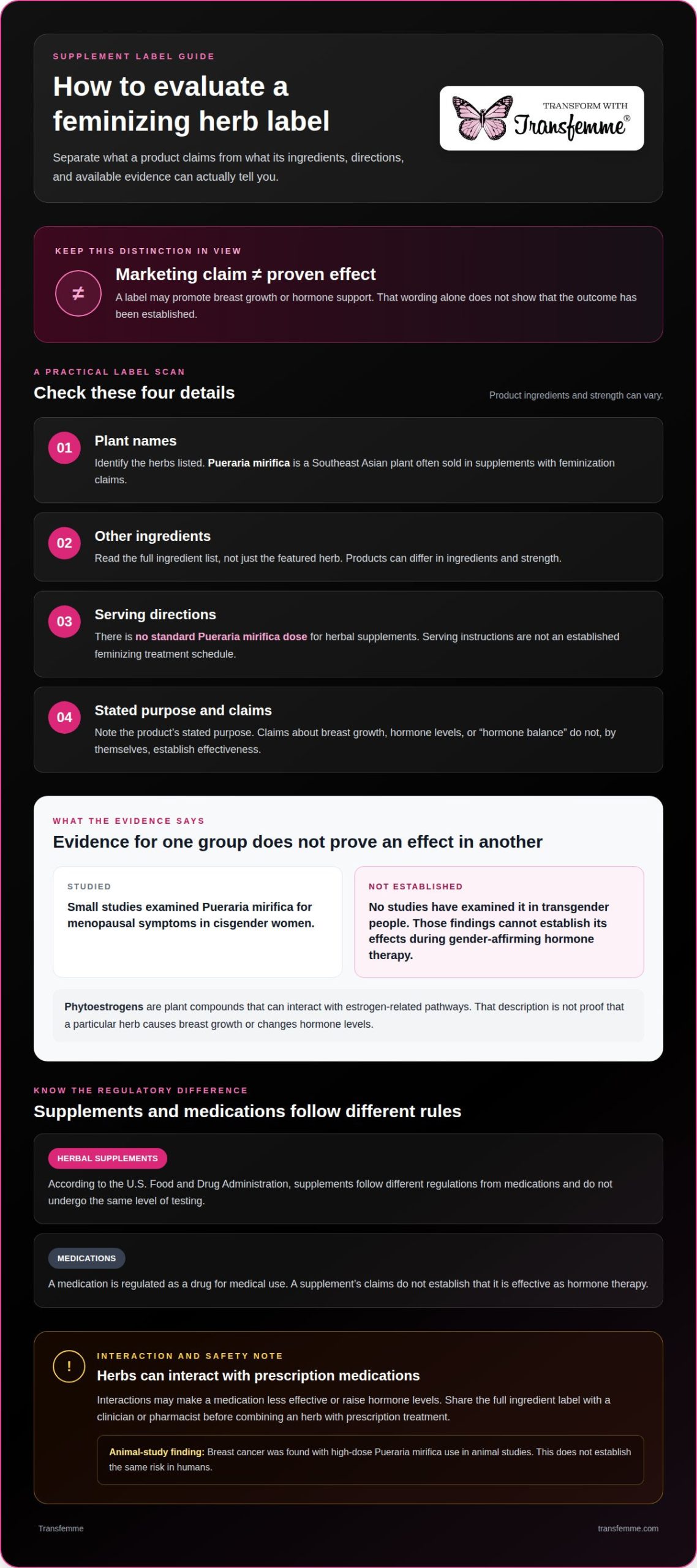
An herbal supplement is a product made with plant ingredients and marketed for consumption. FDA oversight explains how such products are regulated, not whether they produce a particular physical effect. According to the U.S. Food and Drug Administration, herbal supplements in the United States follow different regulations from medications and do not undergo the same level of testing.
A medication is regulated as a drug for medical use. That distinction matters when a supplement label discusses estrogen, hormone levels, breast changes, or other affirming outcomes. Such claims do not establish the product’s effectiveness as hormone therapy. Marketing language and clinical evidence are different kinds of information, so assess them separately.
For a practical review, read the entire product label. Note the plant names, other ingredients, serving directions, and stated purpose. For example, a product promoted for breast growth claims a physical outcome, but that wording alone does not show that studies have established the effect. A claim about supporting hormone balance also does not explain how the product may interact with a medication.
Can feminizing herbs be legally imported or purchased from abroad? There is no blanket yes-or-no answer for every product. Ingredients, labeling, and the claims used to present a product can affect how it is treated under applicable rules. The FDA’s distinction between supplements and medications does not, on its own, establish whether a particular product from abroad can be imported.
Keep safety and regulation separate. The presence of a plant ingredient does not prove that a supplement is safe or effective for a specific use. Evidence about one plant or use does not automatically apply to another formula. If you are considering a product alongside prescribed care, its ingredient list can help a clinician assess possible interactions. A discussion about treatment should address individual health concerns, including cancer history, rather than rely on a supplement’s marketing description.
Can feminizing herbs be legally sold in the U.S.?
A legal sale is one permitted under the rules that apply to a specific product. The legal status of feminizing herbs in the U.S. depends on the product and its claims; the FDA’s general distinction between supplements and medications does not provide a blanket answer for every item sold online or in stores. According to the U.S. Food and Drug Administration, herbal supplements follow different regulations from medications and do not undergo the same level of testing.
A supplement label describes a product’s ingredients and intended use. For products promoted for feminizing effects, distinguish plant ingredients from claims about breast growth or hormone changes. Those claims alone do not establish that a product is an approved medication or demonstrate that it produces the advertised effects.
A product’s presentation includes how its ingredients, label, and marketing describe it. For example, a Pueraria mirifica capsule and a product presented as a medication are not automatically in the same regulatory category. The FDA’s general distinction does not determine the status of an individual product without considering its specific details.
Online availability is not a legal finding. A listing from a U.S. retailer or overseas seller does not establish that every ingredient, label, or claim meets applicable rules. Likewise, describing a product as “natural” does not explain what oversight applies or whether its claims are supported.
To assess a listing, identify the full ingredient name, the product category stated on its label, and the exact claims about feminization. An ingredient name is not evidence of physical effects, and a supplement label is not proof of medication approval. These distinctions are useful whether the listing appears in an online store or on a shelf.
The legal status of feminizing herbs can’t be determined from a product listing alone; the product’s category and claims matter. For a non-prescription option focused on appearance, explore breast-enhancement cream as a separate product category, not as prescription hormone therapy.
Transfemme
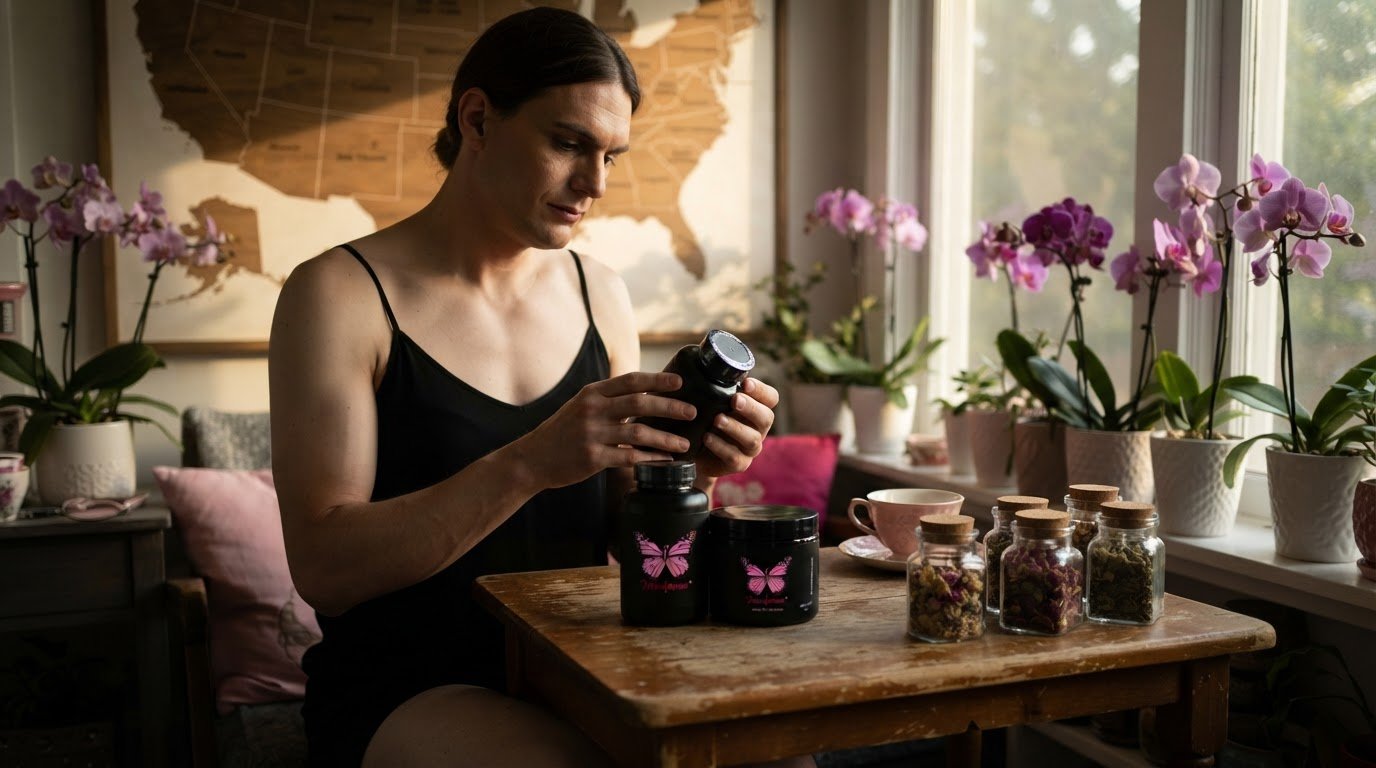
Transfemme offers non-prescription products for people exploring feminine appearance goals alongside questions about herbal supplements. Its offerings include the Boobie Bundle, ALLYOU2GO Bundle™, Transfemme® Pills, and Transfemme Cream Pack. These products are distinct from prescription hormone therapy, and their availability doesn’t establish that herbs are approved or proven to cause feminization.
If you are weighing supplement claims against your personal goals, these distinctions can help you consider what kind of product fits your aims. Transfemme offers pills, creams, and bundles intended to support breast enlargement and feminization goals. Explore Transfemme’s product range to find an option suited to what you are seeking.
Choose a Next Step That Fits Your Goals
Understanding the legal status of feminizing herbs can help you approach product claims with clearer expectations. Identify the changes you are seeking, then consider whether a supplement, cream, or another approach aligns with those goals. Keep personal identity and product effects distinct: your gender is yours to define, while product claims should be assessed on their own terms.
For those exploring non-prescription options, Transfemme offers the Boobie Bundle, ALLYOU2GO Bundle™, and Transfemme® Pills as part of its range for feminization goals. These offerings are not prescription hormone therapy, and they don’t replace individualized medical care. Choose your next step at a pace that feels right for you, with your wellbeing at the center.
For questions about the offerings and how they relate to your goals, contact Transfemme. Your path can be personal, informed, and affirming.
Frequently Asked Questions
Are feminizing herbs legal in the United States?
A product’s feminizing marketing alone does not produce a nationwide yes-or-no answer. Product classification and claims matter, while state restrictions may separately address access to gender-affirming care for minors. For example, a supplement promoted for breast changes should not automatically be treated like a prescription drug. Consider the product’s category and claims as separate questions when assessing its legal status.
Which herbs are marketed as feminizing or estrogenic in the U.S.?
Pueraria mirifica is an herb marketed in products promoted for feminizing effects. Phytoestrogens are plant compounds sometimes discussed in relation to estrogen-related activity, but they are not interchangeable with estrogen medication. An ingredient list can show whether a product contains a named plant; it cannot, by itself, establish that the herb will cause breast growth or other changes for transgender people.
Are feminizing herbs regulated as dietary supplements by the FDA?
Herbal products classified as dietary supplements fall under a different FDA regulatory framework from medications. According to the U.S. Food and Drug Administration, supplements do not undergo the same level of testing as medications. For a specific product, the category stated on its label can help distinguish supplement claims from medication claims. That distinction does not demonstrate that the product produces the feminizing effects described in its marketing.
What FDA rules apply to health claims and labeling for feminizing herbal supplements?
FDA oversight distinguishes herbal supplements from medications, so a supplement’s marketing should not be read as proof of medication approval. For example, an ingredient statement naming Pueraria mirifica is different from a claim that a product will cause breast growth. Read the label and claims together, distinguishing ingredient statements from claims about physical outcomes. Claims alone do not establish effectiveness.
Are feminizing herbs controlled substances or restricted by state law?
The state restrictions discussed here address access to gender-affirming care for minors; they do not establish that a named herb is a controlled substance. These are separate legal questions. A state rule concerning youth care cannot, by itself, determine an herb’s controlled-substance status or whether a particular product may be sold. The product’s ingredients and the specific legal rule matter when assessing each issue.
Do state laws regulate herbal supplements differently across the United States?
State rules differ in their approach to youth access to gender-affirming care, but those restrictions are not automatically herbal supplement laws. For instance, a rule governing care for minors addresses a different issue from federal oversight of dietary supplements. Keep the questions separate: determine whether a state restriction applies to the care or person involved, then consider the product’s category and claims under the relevant supplement framework.