
Non-hormonal feminization products can include supplements and creams marketed for different personal goals, but their labels and advertising don’t guarantee particular physical changes. If you’re looking for a private, non-prescription way to explore your presentation or self-care, it helps to distinguish appearance-focused choices from products marketed to change the body. Supplements, creams, and other options vary in purpose and evidence, and none should be assumed to reliably create changes such as breast growth, altered fat distribution, or reduced body hair.
A clear-eyed approach doesn’t diminish the value of self-care or personal expression. It helps you choose options that fit your goals while keeping possible side effects, interactions, and unsupported promises in view. This guide explains what different product types may and may not do, how to assess ingredient lists and marketing claims, and why supplements and topical creams aren’t substitutes for prescribed medical care. It also offers a practical way to compare options, including Transfemme pills and creams, so you can set realistic expectations and keep your wellbeing in view.
Key Takeaways
- Understand what non-hormonal feminization products are marketed to support, and distinguish personal-expression or skincare goals from expected physical changes.
- Learn why ingredient research or customer testimonials alone can’t establish that a finished product will produce a claimed result.
- Compare supplements and topical creams by format, intended use, evidence limits, and safety considerations, rather than assuming one type is more effective or safer.
- Use a practical checklist to review labels, directions, warnings, claims, and possible interactions with medicines or health conditions.
- Consider how Transfemme® Pills, creams, and bundles might fit into a personal routine without treating them as medical care or expecting guaranteed outcomes.
What Are Non-Hormonal Feminization Products, and What Goals Can They Support?
Non-hormonal feminization products are non-prescription supplements or topical products marketed to support feminization goals without using prescription estrogen. They’re different from prescribed hormone therapy. A product’s marketing, format, or ingredients don’t make it equivalent to estrogen treatment or establish that it can produce lasting physical changes.
The phrase non-hormonal feminization products covers different types of products, from supplements taken by mouth to creams applied to the skin. Some products discuss plant compounds such as phytoestrogens, but information about a class of compounds doesn’t show that a particular finished product changes the body. Look for evidence that relates to the specific product and advertised effect, and treat marketing claims as claims, not guarantees.
Which kinds of products are described as non-hormonal?
Supplements and topical creams are different categories. Supplements are taken by mouth, while creams are applied to the skin. Neither format alone proves effectiveness or safety. Transfemme® Pills are a supplement, while Transfemme Cream and Bountiful Breast Cream Volufiline are topical offerings. The category tells you how a product is used, not what changes you’ll experience.
Keep the intended goal in view. A cream may be part of a personal skincare or body-care routine, while a supplement may be marketed around broader feminization aims. Neither should be assumed to reliably grow breast tissue, redistribute body fat, reduce body hair, or change hormone levels. Individual experiences can differ, and claims need product-specific support.
How do personal goals shape expectations?
Start by naming what you hope to explore. Is your focus skincare, how clothing fits, body shape, or expressing a more feminine presentation? Each goal calls for different expectations. Makeup, clothing, and styling can change your appearance while you use them, but that temporary cosmetic effect isn’t the same as a lasting change to body tissue.
Physical changes are a separate goal, and non-prescription products shouldn’t be treated as a predictable route to them. A product label or testimonial can’t promise how your body will respond. Gender expression and transition goals are personal, and they may shift with time. You can define what feels affirming now, adjust your approach later, and choose self-care that fits your priorities without measuring your identity by a particular result.
What Does the Evidence Say About Non-Hormonal Feminization Products?
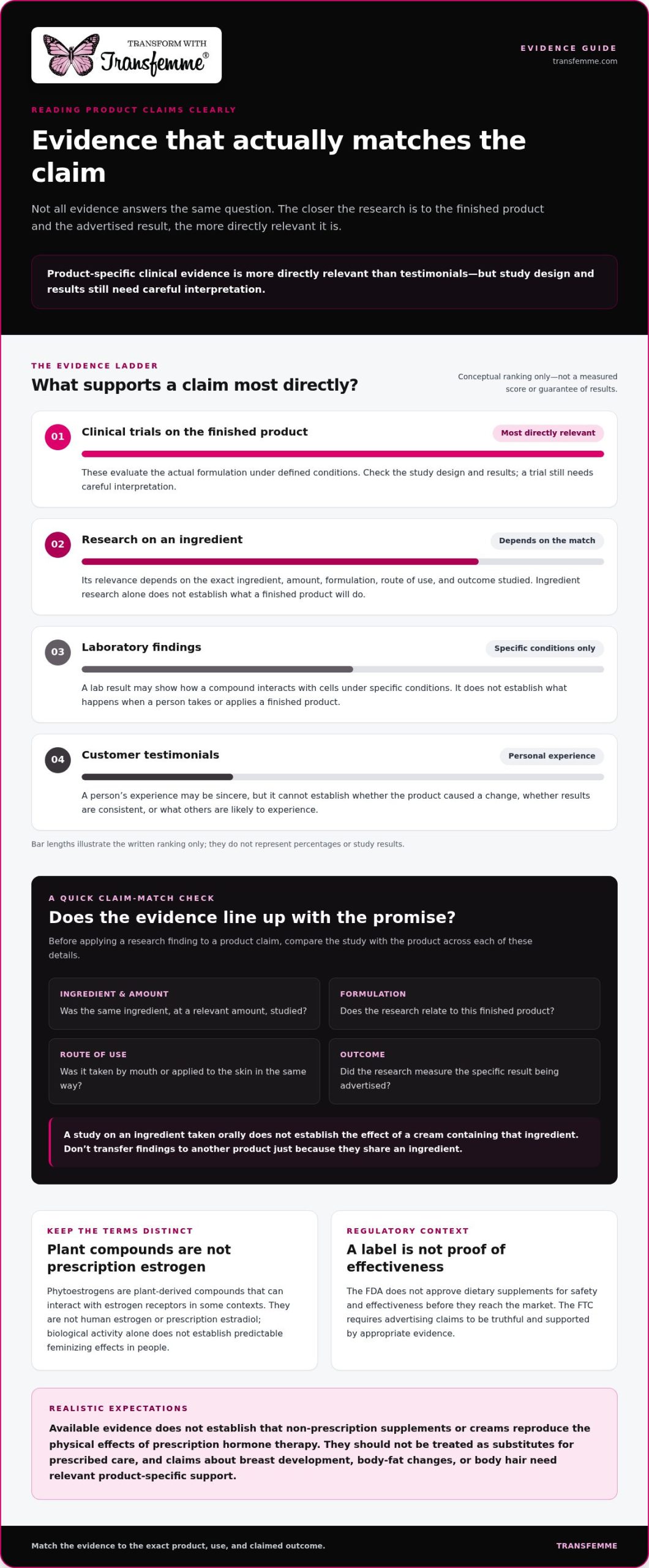
Evidence can sound persuasive while answering a different question from the one you have. A laboratory finding may show that a compound interacts with cells under specific conditions, but that doesn’t establish what happens when a person takes or applies a finished product. Research on an ingredient is another step, but its relevance depends on the exact ingredient, amount, formulation, route of use, and outcome studied. Product-specific clinical trials provide more directly relevant evidence, though their design and results still need careful interpretation.
Product-specific clinical evidence matters more than testimonials because it evaluates the actual formulation under defined conditions, while an individual experience can’t establish cause, consistency, or likely results for others. Testimonials may describe sincerely felt experiences, but they can’t show whether a product caused a change. The FDA does not approve dietary supplements for safety and effectiveness before they reach the market, and the FTC requires advertising claims to be truthful and supported by appropriate evidence.
How can readers assess claims about ingredients?
Match the evidence to the claim. Check whether research tested the same ingredient and formulation, through the same route, for the outcome being advertised. For example, a study on an ingredient taken orally doesn’t establish the effect of a cream containing that ingredient. Be especially cautious about dramatic or guaranteed transformation claims, which call for strong, directly relevant evidence. Don’t transfer a finding from one product to another just because they mention a shared ingredient.
What should readers know about phytoestrogens and estrogen?
Phytoestrogens are plant-derived compounds that can interact with estrogen receptors in some contexts. They aren’t human estrogen or prescription estradiol, and biological activity alone doesn’t establish predictable feminizing effects in people. Research findings can depend on the compound, dose, route, and outcome measured. Acknowledge that uncertainty rather than turning it into a promise. The U.S. National Institutes of Health’s National Center for Complementary and Integrative Health discusses the limits of evidence for some plant-based products, while FDA guidance distinguishes supplements from approved drugs.
For practical decisions, separate what is known about a compound from what is demonstrated for a specific finished product. The available evidence does not establish that non-prescription supplements or creams reproduce the physical effects of prescription hormone therapy. They shouldn’t be treated as substitutes for prescribed care, and claims about breast development, body-fat changes, or body hair require relevant product-specific support.
When comparing non-prescription options, review Transfemme’s supplement and cream options alongside product information and evidence, keeping your goals and expectations in focus.
Supplements, Creams, and Other Options: How Do They Compare?
A product’s format tells you how it’s used, not whether it works or is safer. Compare each option by its intended use, the evidence behind the specific claim, and the precautions relevant to you. The table offers a starting point for that comparison, not a prediction of results.
| Option | Format and intended use | Evidence limits | Safety considerations |
|---|---|---|---|
| Supplements | Taken orally; marketed for various personal feminization goals. Transfemme® Pills are one example. | Evidence about an ingredient doesn’t establish that a particular supplement produces a claimed result. | Review the current label, directions, warnings, and possible interactions with medicines or health conditions. |
| Topical creams | Applied to the skin; may be included in a personal body-care routine. Examples include Transfemme Cream and Bountiful Breast Cream Volufiline. | Results depend on the specific formulation and claim; a cream’s format alone doesn’t prove an effect on breast tissue or other lasting body changes. | Follow the product’s current label and consider skin sensitivity, warnings, and any relevant health concerns. |
| Appearance-focused choices | Clothing, styling, or makeup can help someone explore presentation or create a chosen look. | These choices may change appearance while in use, but aren’t evidence of lasting physical change. | Choose options that feel comfortable and fit your personal needs. |
| Prescription hormone therapy | Prescribed medical care, distinct from non-prescription products. | Its use and expected effects are not established by studies of supplements or creams. | It involves medical guidance and should not be replaced with non-prescription products. |
What are the differences between supplements and topical creams?
Supplements are taken by mouth, while creams are applied to the skin. Absorption and intended use depend on the ingredients and formulation, so don’t assume that products in either category work the same way. Check each product’s own label for directions and warnings. Don’t infer a named product’s ingredients, instructions, or likely results from its format or name.
Where do prescription hormones and non-medical options differ?
Non-hormonal feminization products are not prescription hormone replacement therapy, and supplements or creams shouldn’t be framed as substitutes for gender-affirming medical care. Appearance-focused choices can support expression without being presented as medical treatment or permanent body changes. For related non-surgical context, explore this natural breast growth guide, keeping the distinction between personal approaches and prescribed care clear.
How Can You Evaluate Safety, Labels, and Realistic Expectations?
A careful review can help you make a more informed choice, but it can’t guarantee that a product will be effective or suitable for you. “Natural” and “non-hormonal” don’t mean risk-free: ingredients may cause unwanted effects or interact with medicines, and health conditions can affect what’s appropriate. Use this checklist before starting non-hormonal feminization products.
- Read the full ingredient list. Note each listed ingredient and serving or application amount. Don’t assume products with similar marketing have the same formula.
- Follow the label directions. Use the product only as directed. Taking more, applying it more often, or combining products based on unsupported advice doesn’t establish better results and may increase risk.
- Review warnings and manufacturer information. Look for cautions, intended use, and instructions. If key details are unclear or the label makes dramatic promises, pause and assess the claim carefully.
- Consider your medicines and health conditions. Before use, check potential interactions and relevant cautions with a qualified health professional or pharmacist, especially if you take medication or have a health condition.
- Separate evidence from advertising. A label or testimonial isn’t proof of a guaranteed physical outcome. In the United States, the FDA regulates dietary supplements, but supplements don’t receive FDA premarket approval for safety and effectiveness. See the FDA’s dietary supplement guidance for an overview.
Stop using a product and seek appropriate medical guidance if you experience a concerning reaction. If symptoms feel severe or urgent, seek urgent care. Don’t try to push through a reaction in the hope that it means the product is working.
How can you set realistic goals and track your experience?
Choose goals based on what matters to you, not a promised size, timeline, or transformation. You might focus on how a routine feels, whether it fits comfortably into your self-care, or whether a cosmetic choice supports your presentation. These are meaningful goals that don’t assume a supplement or cream will create lasting body changes.
Keep a simple, consistent record of what you use, when you use it, and any changes or unwanted effects you notice. Starting more than one product at once can make it harder to tell which one may be associated with a reaction. For additional context, read this breast development timeline guide, but don’t treat it as a guaranteed schedule for product results.
As part of your decision, review Transfemme’s supplement and cream options alongside your personal goals and safety needs.
How Can Transfemme Products Fit Into a Personal Feminization Routine?
Once you’ve considered your goals, the evidence, and the product label, you can decide whether a non-prescription option feels right for your self-care routine. Transfemme offers supplements and topical creams for people exploring personal feminization goals. These products are not prescription hormone therapy or medical treatment, and using them is entirely optional.
Which Transfemme products align with different self-care interests?
Transfemme® Pills are a supplement option, while Transfemme Cream, Transfemme Cream Pack, and Bountiful Breast Cream Volufiline are topical cream offerings. The Boobie Bundle and ALLYOU2GO Bundle™ are also part of the product range. Product names and formats can help you identify a category, but they don’t establish ingredients, directions, or likely effects. Review the current label for those details, and keep expectations grounded in product-specific evidence.
If you’re weighing supplement options, the breast enhancement pills guide offers a focused discussion. Keep information about a product category separate from proof that a particular product will create a specific change.
What is a thoughtful next step?
Before adding anything to your routine, revisit what you want to explore. Is your priority a personal self-care ritual, a topical product, or learning more about supplements? Read the product label, follow its directions, and consider any warnings, medicines, or health conditions that may be relevant. Avoid combining options or changing how you use them based on unsupported advice.
Keep your choice low-pressure. You can decide to try a product, take more time to consider it, or choose none at all. Your identity and expression don’t depend on using a particular product, and non-prescription options aren’t replacements for prescribed care. If you’d like to explore the available options, browse Transfemme’s supplement and cream products and review their current product information at your own pace.
Choose a Feminization Path That Feels Right for You
Non-hormonal feminization products come in different formats, but a supplement or cream’s category doesn’t prove it will deliver a specific physical change. Look for evidence tied to the product and claim, read labels and warnings, and consider possible interactions with medicines or health conditions. Keep expectations grounded, and remember that these options are not substitutes for prescribed medical care.
Your goals can guide the next step, whether that means exploring a personal-care routine, learning more about a product, or deciding not to use one. Transfemme offers supplements, topical creams, and bundles for people considering non-prescription options. The company focuses on gender-transition support and has done so for over 20 years.
To explore Transfemme’s supplement and cream options, visit the product range. Whatever you choose, your identity and expression are yours to define, and your wellbeing deserves to remain at the center of every decision.
Frequently Asked Questions
Can you feminize without hormones?
Yes, you can explore feminine presentation without hormones through choices such as clothing, makeup, hair styling, or other appearance-focused approaches. These can change how you look or express yourself without medication. Non-prescription supplements and creams are also marketed for feminization, but they haven’t been established as reliable ways to create lasting physical changes associated with hormone therapy. Your goals are personal, and they don’t need to follow a particular medical or social path.
Do non-hormonal feminization supplements work?
There isn’t enough product-specific evidence to assume that non-hormonal feminization supplements reliably produce physical changes such as breast development or fat redistribution. Research on an individual ingredient doesn’t prove that a finished supplement has the same effect, and testimonials can’t establish what other people will experience. If you’re considering a supplement, review its label and claims carefully, and treat promised transformations as unproven unless supported by relevant evidence.
Are feminization creams safe to use?
Safety depends on the specific cream, its ingredients, how it’s used, and your individual health. A topical product can still cause irritation or other unwanted effects, and “natural” or “non-hormonal” doesn’t guarantee that it’s risk-free. Read the full label, follow its directions, and consider whether warnings apply to you. Stop use if you have a concerning reaction and seek appropriate medical guidance, especially if symptoms are severe or persistent.
Can phytoestrogens cause feminization?
Phytoestrogens are plant-derived compounds that can interact with estrogen receptors in some contexts, but they aren’t the same as human estrogen or prescription estradiol. Their biological activity doesn’t establish that a supplement or cream will cause predictable feminizing changes in people. Effects may depend on the specific compound, formulation, amount, and route, and findings about one ingredient can’t automatically be applied to every product that contains it.
Can non-hormonal products replace HRT?
No. Non-hormonal products aren’t prescription hormone replacement therapy and shouldn’t be used as substitutes for prescribed care. Supplements and creams have not been established as reliable replacements for the physical effects of hormone therapy. If you’re using prescribed treatment, don’t stop or change it based on product advertising or informal advice. Discuss treatment questions and possible interactions with a qualified health professional who understands your health needs and goals.
What should I check before using a feminization supplement?
Read the full ingredient list, serving directions, warnings, and manufacturer information. Don’t exceed the label directions or combine products based on unsupported advice. Check for potential interactions with medicines and consider relevant health conditions with a qualified health professional or pharmacist. In the United States, dietary supplements aren’t approved by the FDA for safety and effectiveness before they reach the market, so a label or testimonial alone can’t guarantee a product’s effects.
How long do non-hormonal feminization products take to work?
There’s no established timeline for feminizing effects from non-prescription supplements or creams, and a specific product may not produce the advertised physical change at all. Be cautious of claims promising a particular result by a set date unless relevant evidence supports that claim. If you choose to use a product, follow its label and keep a record of use and any changes or unwanted effects, without treating time alone as proof it’s working.
Can I use feminization creams and supplements together?
Don’t assume that combining a cream and supplement is safe or more effective. The ingredients, directions, and warnings for each product matter, and a supplement may interact with medicines or be unsuitable for some health conditions. Review both labels and seek guidance from a qualified health professional or pharmacist before combining products, especially if you take medication. Avoid starting multiple products at once, since it can make unwanted effects harder to trace.